
Jane Wyman was one of the last stars of Hollywood’s Golden Age, an Oscar-winning actress whose career ran across six decades. Many people know her only as Ronald Reagan’s first wife. That is the smallest part of her story. She went from chorus girl to respected dramatic lead, won the 1948 Best Actress Oscar for Johnny Belinda, ruled 1950s melodramas, and made a major television comeback in Falcon Crest. She also stayed silent about her famous ex-husband for the rest of her life.
Biography Table
| Field | Details |
|---|---|
| Full Name | Sarah Jane Mayfield (later Sarah Jane Fulks) |
| Nickname/Stage Name | Jane Wyman |
| Date of Birth | January 5, 1917 (some official records suggest 1914) |
| Place of Birth | St. Joseph, Missouri, USA |
| Date of Death | September 10, 2007 |
| Age | 90 (at the time of death) |
| Nationality | American |
| Zodiac Sign | Capricorn |
| Religion | Roman Catholic (convert) |
| Profession/Occupation | Actress, singer, dancer, television producer |
| Years Active | 1932–1993 |
| Genre/Field | Film drama, melodrama, musicals, comedy, television |
| Spouse/Partner | Ernest Eugene Wyman (1933–1935), Myron Futterman (1937–1938), Ronald Reagan (1940–1949), Fred Karger (1952–1955; 1961–1965) |
| Children | Maureen Reagan, Michael Reagan (adopted), Christine Reagan (died a day after birth) |
| Parents | Manning Jefferies Mayfield and Gladys Hope Christian; raised by foster parents Richard and Emma Fulks |
| Height | 5 ft 5 in (approx. 1.65 m) |
| Notable Works | Johnny Belinda, The Lost Weekend, The Yearling, Magnificent Obsession, All That Heaven Allows, Falcon Crest |
| Awards/Honors | Academy Award for Best Actress (1948), Golden Globe Awards, two stars on the Hollywood Walk of Fame |
Early Life and a Difficult Missouri Childhood
Jane Wyman was born Sarah Jane Mayfield in St. Joseph, Missouri, on January 5, 1917. Her parents, Manning Jefferies Mayfield and Gladys Hope Christian, separated when she was very young. Her birth year has long been debated, as some official records point to 1914. She reportedly lied about her age as a teen to find work sooner.
She was raised by foster parents, Richard and Emma Fulks, and took their surname. Her foster mother ran a strict household, and Jane later described an unhappy childhood full of rules and little warmth. She called herself painfully shy, and she said she grew up believing she was not pretty. That feeling followed her for years.
Performing became her escape. Her foster mother pushed her into dance class and ballet lessons, and by around age eight she was trying for film work in Los Angeles. Those early trips failed, and the family returned to Missouri. She disliked school, avoided dating, and spent much of her free time hiding in books.
During the Depression, she dropped out of high school and returned to Hollywood. She worked odd jobs, including waitressing, while job hunting at the studios. When I read her own accounts of these years, what stands out is not bitterness but stubbornness. She simply refused to go home a second time.
From Chorus Girl to Warner Bros. Contract Player
Her first dancing job came in the early 1930s, when she was still about 15 or 16. She danced as one of the anonymous chorus girls in 1930s musicals such as The Kid From Spain (1932) and Busby Berkeley-style productions. Dancing master LeRoy Prinz, a Missouri dance teacher turned Hollywood dance coach, gave her coaching and early chorus roles.
Through the mid-1930s she took bit parts and extra work in films like College Rhythm, King of Burlesque and Stage Struck. In 1936, she signed with Warner Bros., dropped “Sarah,” and became Jane Wyman. The surname came from her first husband, Ernest Eugene Wyman, a salesman she married in 1933.
Warner Bros. quickly typecast her. With platinum blonde hair and heavy false eyelashes, she played the brash, wisecracking girl Friday, the hatcheck girl, ditzy co-eds, and the heroine’s sympathetic best friend. She appeared in second-tier films like Smart Blonde (1937), Public Wedding (1937), Private Detective (1939) and Kid Nightingale (1939).
She finally got leading roles in B-movies. In Torchy Blane… Playing with Dynamite (1939), she played girl reporter Torchy Blane, a character often credited as an inspiration for Superman’s Lois Lane. It was a fun role, but it did not change how the studio saw her.
The real lesson from this period is that she had natural presence before she had a single serious part. Her loud, brassy blonde persona was a costume. Directors who later worked with her said the shyness was still underneath. She was learning to perform confidence long before she felt it.
| Year | Film | Role Type |
|---|---|---|
| 1936 | Stage Struck | Chorus/bit part |
| 1937 | Smart Blonde | Supporting role |
| 1938 | Brother Rat | Supporting role, met Reagan |
| 1939 | Torchy Blane… Playing with Dynamite | First lead |
| 1940 | Tugboat Annie Sails Again | Supporting role |
| 1944 | Make Your Own Bed | Co-star with Jack Carson |
Breakthrough: The Lost Weekend and The Yearling
Her big break came on loan. In 1945, Warner Bros. sent her to Paramount for Billy Wilder’s The Lost Weekend. She played Helen St. James, the understanding girlfriend of Ray Milland’s alcoholic writer. The film won Best Picture, and critics noticed that she brought real depth to a quiet role.
The following year, MGM borrowed her again for The Yearling (1946). She played Ma Baxter, a hardened farmer’s wife in 1870s Florida who has lost several children and guards her surviving son with fierce coldness. She wore little makeup and dropped every trace of her brassy screen image.
That performance earned her first Academy Award nomination. She was in her early 30s and had been in Hollywood for more than 15 years. It was the turning point that proved her dramatic ability to the industry, and especially to her home studio.
Before this, she had been a dependable frequent co-star, often next to Jack Carson in comedies like Princess O’Rourke (1943). After The Yearling, she pushed for serious parts and said she worked harder than ever. These two loan-out films showed that her best work often came when she was away from the roles Warner Bros. had built for her.
Johnny Belinda and the 1948 Best Actress Oscar
Johnny Belinda (1948) is the film that defines Jane Wyman’s career. She played Belinda, a deaf-mute farm girl in a remote community who is raped by a local man and gives birth to a son she names Johnny. A kind doctor, played by Lew Ayres, teaches her sign language and defends her.
The subject was daring for censorship-era Hollywood. Warner Bros. was nervous about the film and reportedly thought it would fail. Instead, it became a hit and earned 12 Academy Award nominations, including Best Picture, Actor, Director, Supporting Actor and Supporting Actress.
She prepared for the role for months. She studied sign language, worked with deaf people, and wore earplugs on set to block sound so her reactions would feel authentic. She was completely absorbed in the part, which gives the performance its quiet power. She never speaks a line, yet you always know the character’s thoughts.
On March 24, 1949, she won the Best Actress Oscar, beating Ingrid Bergman, Olivia de Havilland and Barbara Stanwyck. Her acceptance speech was famously short. She joked that she was accepting the award for keeping her mouth shut once and planned to do it again.
When I rewatch it today, the film still holds up because she never asks for pity. It was her favorite performance and the role that gave her lasting confidence. After winning, she was no longer a contract player hoping for a chance. She was a leading lady who could choose her projects.
Jane Wyman Spouse History: Five Marriages to Four Men
Jane Wyman married five times to four men. Most of her marriages were brief, and she once joked that she was not the permanent marrying kind. Her best-known spouse is Ronald Reagan, but her full marriage record shows a woman who kept searching for stability.
| Spouse | Married | Divorced | Notes |
|---|---|---|---|
| Ernest Eugene Wyman | 1933 | 1935 | Gave her the surname Wyman |
| Myron Futterman | 1937 | 1938 | Dress manufacturer about 15 years her senior |
| Ronald Reagan | 1940 | 1949 | Her only long marriage; two children |
| Fred Karger | 1952 | 1955 | Bandleader and composer |
| Fred Karger | 1961 | 1965 | Remarried, then divorced again |
Her second husband, Myron Futterman, was a dress manufacturer roughly 15 years older than her. That marriage lasted only months. She later said they wanted different things, and the age gap made it hard for them to connect.
Fred Karger, a bandleader and music coach at Columbia, was the only man she married twice. Their second attempt in the early 1960s also ended in divorce. After 1965, she never remarried and spent the rest of her life focused on work, faith and family.
Life With Ronald Reagan and the 1949 Divorce
Jane Wyman and Ronald Reagan met as co-stars at Warner Bros. in the late 1930s, and were paired in Brother Rat and Brother Rat and a Baby. They married in 1940 and became one of Hollywood’s most popular young couples. Studio publicity treated them as the perfect wholesome pair.
During WWII, Reagan, nicknamed “Dutch,” was kept stateside because of poor eyesight. He served as a personnel officer and made training films in Culver City. Meanwhile, her stardom was rising fast. By the late 1940s, she was a bigger name than he was, a shift that changed the balance in their marriage.
The marriage became troubled around 1947. Reagan was deeply involved as Screen Actors Guild president and spoke constantly about politics and communism. Wyman reportedly felt bored and frustrated by his obsession with politics. Her total immersion in Johnny Belinda also pulled them in different directions.
Personal tragedy added to the strain. In 1947, she gave birth to a premature daughter, Christine, who died a day later, while Reagan was seriously ill with pneumonia. She filed for divorce in 1948, and the divorce was finalized in 1949. Gossip linked her to co-star Lew Ayres, but an affair was only ever rumored.
Reagan was devastated and stayed quiet in public. He is often quoted as joking that he would name Johnny Belinda as co-respondent. Years later, he became the first divorced man elected president. Her divorce is now seen as an early chapter in his path to the presidency.
Jane Wyman and Nancy Reagan Relationship
There was no close relationship between Jane Wyman and Nancy Reagan. Nancy married Ronald Reagan in 1952, three years after his divorce from Jane. The two women moved in overlapping circles but kept a polite distance for the rest of their lives.
Jane never criticized Nancy publicly and never offered opinions about her role as First Lady. This fit her overall rule of not discussing ex-husbands or their wives. She reportedly considered it bad taste to talk about such things in interviews.
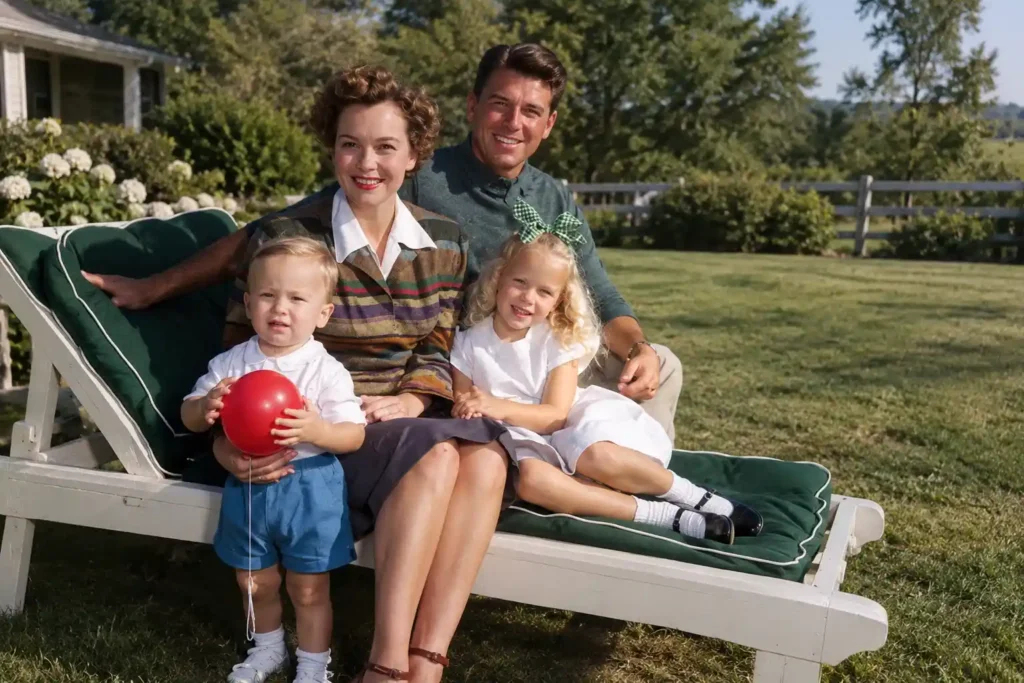
The main connection between them was family. Jane’s children with Reagan, Maureen and Michael, became part of the wider Reagan household, with relationships that were sometimes complicated. Michael Reagan later wrote about feeling pulled between his parents’ separate worlds, but Jane herself stayed out of those public discussions.
Jane Wyman at Ronald Reagan’s Funeral
Jane Wyman did not attend Ronald Reagan’s funeral in 2004. By then she was elderly and largely retired from public life. Her absence fit the private approach she had kept for over five decades since their divorce.
She did, however, break her silence briefly after his death. She released a short statement calling him a great president and a kind and gentle man. It was one of the very few public comments she ever made about him.
For decades before that, she rarely discussed the marriage. She was known to end an interview, or even walk out, if reporters pushed her about the president’s ex-wife angle. She refused offers to write a tell-all, even when interest peaked during the 1980s.
Her silence was respected in Hollywood and across the country. In my view, it is one of the most striking parts of her life. Many ex-spouses of presidents cashed in on their connection. Jane Wyman never praised or attacked him for publicity, and that restraint protected both her children and her own reputation.
Children: Maureen, Michael and Christine
Jane Wyman had three children with Ronald Reagan. Maureen Reagan was born on January 4, 1941. She later became a political commentator and activist, and she died in 2001. She was close to her mother and often spoke about her as a complicated woman with a strong work ethic.
In 1945, the couple adopted Michael, born to Irene Flaugher in Ohio. Michael Reagan later wrote the memoir Twice Adopted, which described his difficult childhood and his relationship with both parents. Like Maureen, he remained publicly loyal to his mother.
Their second daughter, Christine, was born prematurely in 1947 after a long labor and died a day later. Jane rarely spoke about this loss. Biographers often point to it as a deep wound that came at the worst possible moment in her marriage.
She raised Maureen and Michael largely as a hardworking single mother during the 1950s. Like many studio-era stars, she was strict and often busy. Still, she never allowed her children to become fodder for sensational memoirs or tabloid stories while she was alive.
Jane Wyman Movies: The 1950s Melodrama Years
After her Oscar, Jane Wyman became the leading melodrama star of the 1950s. She played brave women facing loss, illness and social judgment. These tearjerkers were hugely popular with audiences, especially women, and made her one of the decade’s most bankable actresses.
Her early 1950s work included Alfred Hitchcock’s Stage Fright (1950) and The Glass Menagerie (1950). The Blue Veil (1951), about a devoted nursemaid, earned her another Oscar nomination. In So Big (1953), she played a self-made career woman who builds a life on her own terms.
Her partnership with director Douglas Sirk produced her signature roles. In Magnificent Obsession (1954), she played a woman blinded in an accident, earning her fourth Best Actress nomination. All That Heaven Allows (1955) cast her as a widow criticized by her community for loving a younger gardener, played by Rock Hudson.
Critics once dismissed these films as soap operas. Today, they are seen as sophisticated studies of American society, class and women’s roles. Watching All That Heaven Allows now, I notice how much she conveys through stillness. Her performances in these films were unfairly underrated for decades.
Singing, Musicals and Comedy Roles
Jane Wyman began in musicals and never fully left them. She had a strong song-and-dance career foundation from her chorus years. In Hollywood Canteen (1944), she performed alongside Warner stars in a wartime musical tribute.
Her best musical moment came in Here Comes the Groom (1951), directed by Frank Capra. She sang the duet “In the Cool, Cool, Cool of the Evening” with Bing Crosby. The song won the Academy Award for Best Original Song, and it showed audiences a lighter side of her talent.
She reunited with Crosby in Just for You (1952). She also made light comedies like Three Guys Named Mike (1951), where she played an airline stewardess. These films balanced her heavier dramatic work and kept her career flexible.
Jane Wyman Movies and TV Shows at a Glance
For readers searching for Jane Wyman movies and TV shows in one place, this table covers her most important work across film and television.
| Year | Title | Type | Why It Matters |
|---|---|---|---|
| 1938 | Brother Rat | Film | First pairing with Ronald Reagan |
| 1945 | The Lost Weekend | Film | First major dramatic breakthrough |
| 1946 | The Yearling | Film | First Oscar nomination |
| 1948 | Johnny Belinda | Film | Won Best Actress Oscar |
| 1950 | Stage Fright | Film | Hitchcock thriller |
| 1951 | The Blue Veil | Film | Oscar nomination |
| 1951 | Here Comes the Groom | Film | Oscar-winning song with Bing Crosby |
| 1954 | Magnificent Obsession | Film | Oscar nomination, Douglas Sirk |
| 1955 | All That Heaven Allows | Film | Sirk classic with Rock Hudson |
| 1955–1958 | Jane Wyman Presents The Fireside Theatre | TV | Host, actress and producer |
| 1960 | Pollyanna | Film | Disney family hit |
| 1981–1990 | Falcon Crest | TV | Comeback as Angela Channing |
| 1993 | Dr. Quinn, Medicine Woman | TV | Final appearance |
Television Career and the Falcon Crest Comeback
Jane Wyman was one of the first major film stars to move into television. In 1955, she launched the anthology series Jane Wyman Presents The Fireside Theatre, later called Jane Wyman Theater. She hosted, acted and worked as producer, which gave her rare creative control for an actress at that time.
Her film career slowed after the early 1960s, and she semi-retired. Then in 1981 came a remarkable acting comeback. She was cast as Angela Channing, the cold, domineering matriarch of a California wine empire, in Falcon Crest. The show ran for nine seasons and competed with hits like Dallas and Dynasty.
The timing was striking. Falcon Crest premiered the same year Ronald Reagan became the 40th president. Reporters loved the angle, but she refused to let it overshadow the show. She reportedly became one of TV’s best-paid stars, with jokes that she earned more per week than the presidential salary.
Angela Channing was a villain role, but she played it with wit and control. She won the 1984 Golden Globe for it. Health problems limited her during the final season, and she retired from regular acting after the show ended. Her final appearance came in 1993 on Dr. Quinn, Medicine Woman, alongside Jane Seymour.
Cheesecake Photos and the “Jane Wyman Nude” Search Myth
Searches for “cheesecake Jane Wyman” refer to her 1930s and early 1940s studio publicity photos. Cheesecake was the industry term for glamour shots that showed off a starlet’s legs, swimsuits or playful poses. Warner Bros. took hundreds of these photos of its young contract players.
Her cheesecake era matched her blonde bombshell image. These pin-up style photos were sent to magazines and, during WWII, to soldiers at military camps. They were part of every studio’s marketing plan, not a personal choice.
As for “Jane Wyman nude” searches, there are no nude scenes in any of her films. Studio-era Hollywood worked under strict censorship rules, and she never posed nude. Images online claiming otherwise are misattributed or fake. Her publicity photos were tasteful by the standards of her time.
Her image changed after The Yearling and Johnny Belinda. Once she became a respected dramatic actress, the studio dropped the leg art. That shift tells you how carefully Hollywood shaped stars, and how hard she worked to escape the box she started in.
Faith and Catholic Conversion
Jane Wyman converted to Catholicism in the 1950s, and faith became central to her life. An elderly priest served as her spiritual mentor, helping her deal with lifelong shyness and self-centeredness. She said her faith taught her to focus outward on other people instead of herself.
She became deeply devoted to the Dominican order. She was a lay member and admired St. Catherine of Siena. She credited God with her talent and success, and she viewed her career as something to give back through charity work.
When she died, she was buried in a Dominican habit, a sign of how seriously she took her religious commitments. Friends said her acceptance of illness and aging came from her faith. She died with dignity and without public drama.
Off-Screen Personality and Friendship With Rock Hudson
On sets, Jane Wyman was well liked by casts and crews. She was bluntly honest, dependable and generous. She also loved pranks, which surprised people who knew only her serious screen roles. Co-stars described her as loyal and quick to defend people she cared about.
Her friendship with Rock Hudson was one of her most lasting. They starred together in Magnificent Obsession and All That Heaven Allows, and she helped him grow as an actor. She was accepting of his sexuality long before the public knew about it.
When Hudson died of AIDS in 1985, she publicly praised him as a man and an actor. She was angered by the tasteless press coverage of his illness and death. For someone so guarded, speaking out showed how much she valued that friendship.
Her guarded nature came from childhood. She once said that winning the Oscar was what finally helped her open up. Before that, she was closed and cautious and hid behind a persona. Through work and faith, she became willing to risk being hurt, which was her lasting answer to shyness.
Awards and Honors
Jane Wyman’s awards cover both film and television, which few stars of her era achieved. Her four Best Actress Oscar nominations place her among the top dramatic actresses of the 1940s and 1950s.
| Award | Year | For |
|---|---|---|
| Academy Award Nomination – Best Actress | 1947 | The Yearling |
| Academy Award – Best Actress (Won) | 1949 | Johnny Belinda |
| Golden Globe – Best Actress (Won) | 1949 | Johnny Belinda |
| Academy Award Nomination – Best Actress | 1952 | The Blue Veil |
| Golden Globe – Best Actress (Won) | 1952 | The Blue Veil |
| Academy Award Nomination – Best Actress | 1955 | Magnificent Obsession |
| Primetime Emmy Nominations | 1957, 1959 | Jane Wyman Theater |
| Golden Globe – Best Actress TV Drama (Won) | 1984 | Falcon Crest |
She also earned two stars on the Hollywood Walk of Fame, one for film and one for television. Her handprints and footprints are set at Grauman’s Chinese Theatre, a classic Hollywood honor.
Death and Legacy
Jane Wyman died on September 10, 2007, at her home in Rancho Mirage, California, at age 90. Her health had declined in her final years, and she lived quietly in retirement. She spent much of that time painting and supporting charity work.
Her obituaries often led with her marriage to Reagan. That frustrated many classic-film fans, because it overshadows her consistently excellent work. She won an Oscar, starred in iconic melodramas and led a hit TV series in her 60s. Few actresses of her generation managed that range.
For years, her work was taken for granted and undervalued. Her quick B-movies are now obscure, and her Sirk work faded from memory for a time. Today, film historians and fans see her differently. She is remembered as a gifted, serious actress who built her own career with little help.
FAQs
How Many Times Was Jane Wyman Married?
Jane Wyman married five times to four men. Her husbands were Ernest Eugene Wyman, Myron Futterman, Ronald Reagan and Fred Karger, whom she married twice. Her marriage to Reagan was her longest, lasting about nine years.
Did Jane Wyman Ever Remarry After Fred Karger?
No. After her second divorce from Fred Karger in 1965, she stayed single for the rest of her life. She focused on her career, her children and her Catholic faith instead.
Why Did Jane Wyman and Ronald Reagan Divorce?
The commonly reported reasons include growing incompatibility, the loss of their premature daughter, and her frustration with his intense focus on politics. She herself never publicly confirmed a reason and refused to discuss the divorce.
What Was Jane Wyman’s Last Movie?
Her last feature film was How to Commit a Marriage (1969), a comedy with Bob Hope. After that, she worked mainly in television, ending with Falcon Crest and a 1993 guest role.
Did Jane Wyman Ever Meet Nancy Reagan?
They crossed paths through family connections, but there was never a friendship. Jane Wyman avoided public comments about Nancy and kept a respectful distance throughout both of their lives.
Where Is Jane Wyman Buried?
She was buried at Forest Lawn Cathedral City in California, dressed in a Dominican habit, reflecting her devotion to her Catholic faith.
Read About : love is blind season 9 cast