Alison Botha’s name has become synonymous with survival against impossible odds. In December 1994, the Port Elizabeth insurance broker was abducted, raped, and left for dead — yet she crawled back to life and turned unimaginable brutality into a message of hope. Decades later, the story of Alison Botha continues to resurface, from parole hearings involving her attackers to her own fight through a life-threatening brain aneurysm.
Alison Botha: Biography Table
| Field | Details |
|---|---|
| Full Name | Alison Botha |
| Date of Birth | September 22, 1967 |
| Place of Birth | Port Elizabeth (now Gqeberha), South Africa |
| Age | 58 |
| Nationality | South African |
| Profession/Occupation | Motivational speaker, author, survivor advocate |
| Years Active | 1998–present (as author and speaker) |
| Education | The Collegiate High School for Girls; Port Elizabeth Technikon |
| Spouse/Partner | Single mom |
| Children | Two sons |
| Parents | Mother: Claire Collier |
| Siblings | Brother: Neale |
| Notable Works | I Have Life: Alison’s Journey (book); Alison (2016 documentary) |
| Awards/Honors | Port Elizabeth Citizen of the Year (1995); Woman of Courage Award; Rotarian Paul Harris Award |
Who Is Alison Botha? Early Life and Background
Alison Botha was born on September 22, 1967, and grew up in Port Elizabeth, South Africa, a coastal city now known as Gqeberha. She attended The Collegiate High School for Girls, where she held the position of head girl, a role that hinted at the quiet resilience and sound moral values she would later be known for.
After matriculating, Botha studied at Port Elizabeth Technikon and went on to travel overseas before returning home to build a normal life. Her parents had divorced when she was young, but by her mid-twenties she had settled into steady work as an insurance broker, enjoying an ordinary, quiet life with her brother Neale nearby.
By age 27, Botha had a new job, a small apartment near the beach, and a close circle of friends. Nothing about her routine on the night of December 18, 1994, suggested that her life was about to change forever — she was simply dropping friends home after a relaxed evening together.
The Night of the Abduction
On the warm night of December 18 into December 19, 1994, Botha was driving home after spending the evening with friends. As she parked in her usual spot outside her apartment, a man carrying a knife forced his way into her vehicle before she could get inside.
The attacker, who identified himself only as “Clinton,” ordered her to move over and threatened to kill her if she resisted. Moments later, a second man climbed into the car. The two men, later identified as Theuns Kruger and Frans du Toit, took control of the vehicle and drove her out of the city toward a secluded, wooded nature reserve on the outskirts of Port Elizabeth.
During the drive, Botha pleaded with the men to simply take her car and leave her unharmed. Du Toit and Kruger, both already out on bail for similar offences at the time, had a documented history of previous kidnappings and were serial rapists working in tandem — later dubbed the “Ripper Rapists” by the South African press.
The Brutal Attack in Gqeberha
Once at the secluded clearing, Kruger and du Toit both raped Botha before turning violent with the intention of killing her. Kruger cut her throat, and in the assault that followed, her throat was slashed 16 times and her abdomen stabbed more than 50 times, leaving her disembowelled on the sand.
The attackers believed they had killed her and left her for dead in the clearing, satisfied their crime was complete. What they didn’t account for was Botha’s extraordinary will to survive — even as she lost consciousness intermittently, she held her own intestines in place with one hand and used her other hand to keep her nearly severed head from falling backward.
Alison Botha’s injuries were later described by treating physicians as some of the worst survivable wounds they had ever encountered — her throat was cut so deeply it left her semi-decapitated, and her abdomen wounds were too numerous for doctors to count with confidence.
The Miraculous Rescue
Despite her catastrophic injuries, Botha began crawling — first through debris and broken glass, then along a dirt road, inch by inch, in search of help. Her sight faded in and out as she struggled forward, but she kept moving toward the road where a passing motorist might see her.
A passing motorist eventually spotted her lying across the road and stopped to help, alongside a second car that arrived shortly after. Emergency services were called, and Botha was rushed to hospital, where a doctor who happened to have attended one of her old school talks recognized her.
Physicians who treated Botha at the time called her survival a medical miracle. Given the extent of her wounds — a nearly decapitated throat and exposed, disembowelled organs — doctors were stunned that she remained conscious and coherent enough to describe her attackers to police almost immediately after the attack.
Trial and Sentencing of Her Attackers
Theuns Kruger and Frans du Toit were arrested swiftly, in part because Botha remembered every detail about them and was able to identify them from police photographs. The case, tried in the Port Elizabeth High Court in August 1995, became one of the most closely followed criminal trials in South Africa at the time.
Both men were found guilty on multiple charges, including attempted murder, kidnapping, and rape. Kruger was sentenced to life imprisonment plus 25 years, while du Toit received three life sentences. The presiding judge stated plainly that men capable of this level of violence needed to be removed from society for the rest of their lives.
Psychological evaluations conducted after their incarceration found Kruger to suffer from Borderline Personality Disorder, while both men were later diagnosed with traits consistent with psychopathy and narcissism — findings that would resurface decades later during parole debates.
Alison Botha’s Attackers: Where Are They Now
Frans du Toit and Theuns Kruger remain two of the most notorious names connected to Alison Botha’s story. Both men were serving life sentences under South Africa’s Correctional Services Amendment Act of 1959, which allowed prisoners sentenced before 1998 to be considered for parole after serving 20 years.
In July 2023, both attackers were granted parole and released under supervision, a decision that blindsided Botha, who says she learned of their release through the media rather than through any formal victim notification process. She was registered with the Department of Correctional Services but was not consulted ahead of the decision.
Botha publicly said she was left feeling disillusioned and terrified by the news, having spent nearly three decades believing the men who nearly killed her would never walk free again.
Parole Release in July 2023
The 2023 parole decision, made by the National Council of Correctional Services, sparked outrage among South Africans who remembered the brutality of the original case. Botha’s legal representative, attorney Tania Koen, was vocal in criticizing how little input victims had in the process.
Botha declined to personally meet with either of her attackers as part of any Victim Offender Dialogue programme, though both men were reportedly registered for such conversations. She has said she simply hoped she would never have to think about the possibility of their freedom again.
The backlash from the case helped fuel broader conversations in South Africa about victim participation rights and the transparency of parole board decisions for life-sentenced offenders.
Parole Revoked: February 2025 Reincarceration
In a rare and historic move, South Africa’s Minister of Correctional Services, Dr. Pieter Groenewald, announced in February 2025 that he was revoking the parole granted to both du Toit and Kruger. Both men were rearrested at their homes on February 4, 2025, and returned to custody.
The Minister said the decision followed a thorough evaluation and consultation of legal opinions, noting that the original 2023 parole decisions had lacked adequate victim and complainant participation. Legal analysts described it as likely the first time in South African history a Minister had used this authority to cancel parole for life-sentenced prisoners in this way.
Botha responded publicly, saying she finally felt she could breathe again. Her legal team and advocates, including Tania Koen, called the reversal a victory not just for Botha but for survivors of violent crime across the country, though some legal experts questioned whether retrospective application of newer sentencing law to a 1997 conviction could raise constitutional concerns.
Alison Botha’s Injuries and Long-Term Health
The physical toll of the 1994 attack never fully left Botha. She has spoken openly about living with chronic headaches and permanent scarring since the assault, alongside years of psychological healing that included periods of depression.
Beyond the visible injuries — the throat scarring and abdominal trauma — Botha has described the long road of relearning trust, safety, and a sense of control over her own body. Her openness about these lasting effects has made her story resonate with survivors of sexual violence well beyond South Africa.
The 2024 Brain Aneurysm and Recovery
In September 2024, three decades after her original attack, Botha suffered a massive brain aneurysm. She initially dismissed a headache before her condition rapidly deteriorated, and she was later found collapsed by one of her sons.
She was airlifted by Air Mercy Services and treated first in George before being transferred to Groote Schuur Hospital in Cape Town, where she underwent multiple surgeries, including one to relieve dangerous fluid build-up on her brain. At the time, she was unable to speak, move, or turn herself over in bed.
A trust account was set up by her legal team to help cover mounting medical expenses, drawing international donations and well-wishes as news of her condition spread. Botha has since described 2024 as one of the hardest years of her life, requiring her to relearn basic tasks like walking and feeding herself through occupational therapy and physiotherapy.
By her own account, Botha has continued to defy medical expectations, crediting the same resilience that carried her through 1994 with helping her push through this second, unrelated health crisis.
I Have Life: The Book
Botha’s memoir, I Have Life: Alison’s Journey, was first published in 1998 through Penguin Random House and quickly became a South African bestseller, selling over 95,000 copies. Ghostwritten with journalist Marianne Thamm, the book offers a first-person account of the attack, her recovery, and her decision to speak publicly about surviving rape.
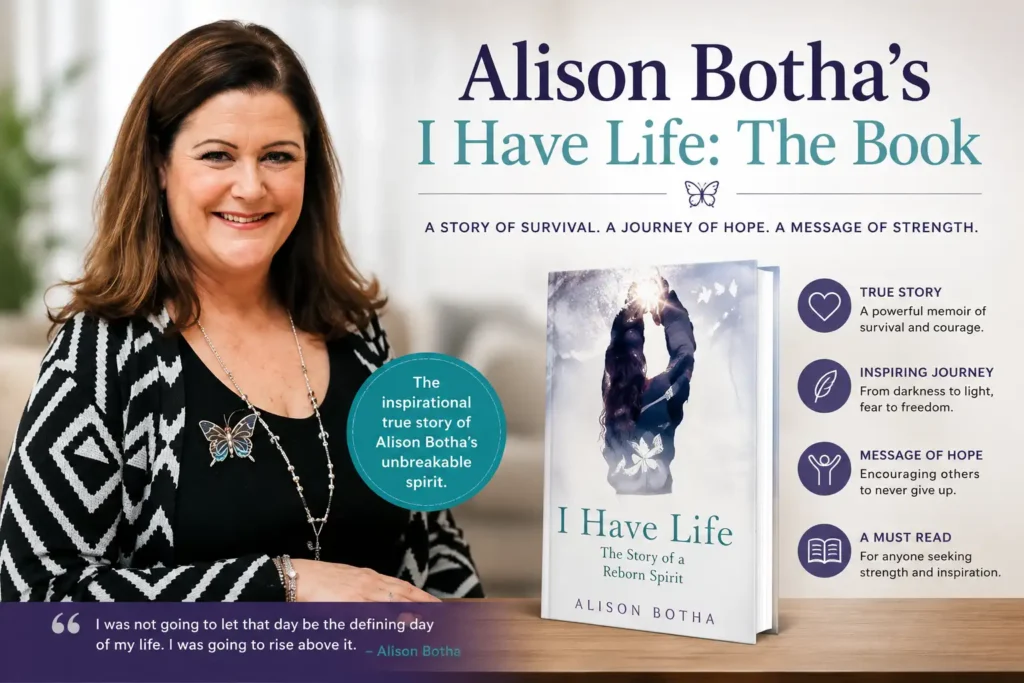
The book has since been translated into seven languages and reprinted multiple times, including an updated chapter added for its 2016 re-release. Botha has said she wrote it hoping her story would give others facing trauma both hope and a sense of agency in their own healing.
Alison (2016): The Documentary and Movie
In 2016, director Uga Carlini released Alison, an award-winning South African documentary blending re-enactments with interviews to tell Botha’s story on screen. The film premiered at the Dances With Films Festival and combined the emotional weight of her memoir with a visual retelling of the attack, rescue, and aftermath.
Botha has said watching the finished film was difficult, admitting she has never been able to sit through the full movie or reread her own book in one sitting. Even so, she has embraced the way the documentary introduced her story of survival and courage to audiences who might never have picked up the book.
Motivational Speaking Career
Botha became one of the first South African women to speak publicly about surviving rape, eventually building an international career as a motivational speaker. She has addressed audiences in more than 30 countries, from corporate events to schools, sharing what she calls her “Attitude, Belief, Choice” philosophy.
Her keynote talks focus less on the details of the attack itself and more on mental resilience — the idea that while people cannot control what happens to them, they retain control over how they respond. She has said repeatedly that she believes far more good has come from her choice to speak out than harm ever caused by her attackers.
Over the years, Botha has said she is often approached afterward by other survivors who tell her that hearing her story gave them the courage to come forward about their own experiences, something she considers central to why she keeps sharing it.
Awards and Recognition
Botha’s advocacy and personal resilience have earned her numerous honors over the years. In 1995, she was named Port Elizabeth’s Citizen of the Year, becoming the first recipient of that title. She has also received Femina magazine’s Woman of Courage award and the Rotarian Paul Harris Award for her humanitarian contributions.
Universities, including Nelson Mandela Metropolitan University, have invited her to speak at events tied to Women’s Month and gender-based violence awareness, recognizing her as an embodiment of courage beyond the norm.
Family Life
Botha has raised two sons as a single mother, describing them as the greatest gift to come out of her survival. She has spoken about the emotional weight of knowing her attackers specifically intended to destroy her reproductive organs during the assault, making the birth of her children feel even more significant to her personally.
Her brother, Neale, and mother, Claire Collier, have remained close throughout her recovery from both the original 1994 attack and her 2024 health crisis, with her son playing a direct role in getting her emergency medical help during the aneurysm.
Reflections on Survival and Philosophy
Botha often repeats a core belief in her talks: life isn’t defined by what happens to a person, but by how they respond to it. She has said she made a conscious decision not to carry hatred toward her attackers, choosing instead to focus on what she could control.
She has also pushed back against the idea that survivors owe anyone silence or shame, arguing instead that speaking openly about trauma — including sexual violence — is part of what allowed her to reclaim her own story rather than let the attack define her.
Where Is Alison Botha Now (2025)?
As of 2025, Botha is focused on recovery from her brain aneurysm while continuing to follow developments in her attackers’ legal status. With both Kruger and du Toit reincarcerated since February 2025, she has said she finally feels a measure of the safety she lost decades earlier.
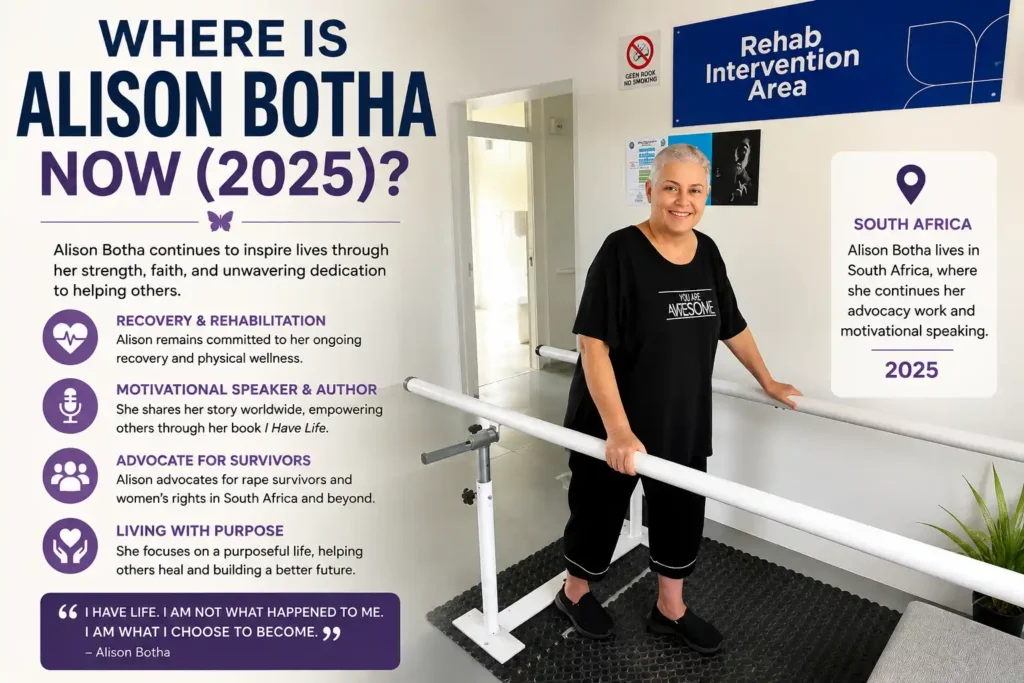
She continues to be represented by attorney Tania Koen and remains a prominent voice in South African conversations about victims’ rights within the parole and correctional systems, even as she works through ongoing physical rehabilitation from her more recent health scare.
Frequently Asked Questions
What happened to Alison Botha?
In December 1994, Alison Botha was abducted at knifepoint outside her Port Elizabeth apartment by two men, Theuns Kruger and Frans du Toit. She was raped, had her throat cut, and was stabbed and disembowelled before being left for dead in a secluded area.
Who were Alison Botha’s attackers?
Her attackers were Theuns Kruger and Frans du Toit, both convicted in 1995 and sentenced to life imprisonment for rape, attempted murder, and kidnapping. Psychological evaluations later found signs of psychopathy and narcissistic traits in both men.
Is Alison Botha still alive in 2025?
Yes, Alison Botha is alive as of 2025. She survived a serious brain aneurysm in September 2024 and has been recovering through ongoing physiotherapy and occupational therapy.
Did Alison Botha’s attackers get released from prison?
Yes, Kruger and du Toit were granted parole in July 2023. However, that parole was revoked in February 2025 by South Africa’s Minister of Correctional Services, and both men were reincarcerated.
What injuries did Alison Botha survive?
Botha survived having her throat slashed 16 times and her abdomen stabbed more than 50 times, resulting in disembowelment and a near-decapitation. Doctors at the time called her survival a medical miracle.
Is there a movie about Alison Botha’s story?
Yes, a 2016 South African documentary titled Alison, directed by Uga Carlini, tells her story through re-enactments and interviews. It is based on the same events covered in her memoir, I Have Life: Alison’s Journey.
What is Alison Botha’s book called?
Her memoir is titled I Have Life: Alison’s Journey, first published in 1998 and later translated into seven languages, detailing her survival, recovery, and decision to become a public advocate for survivors of sexual violence.
Read About : heidi gardner