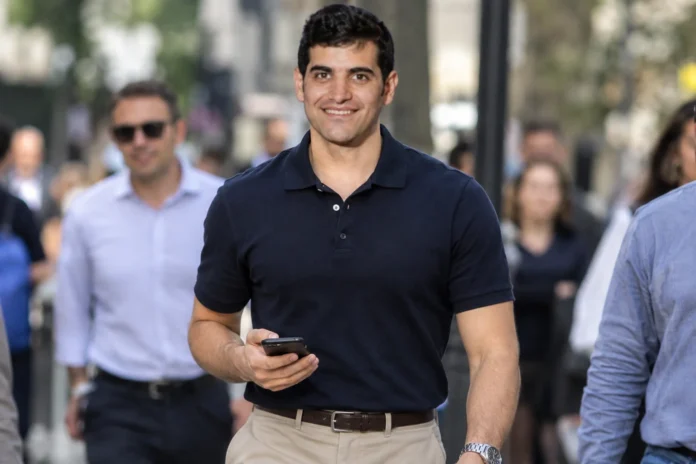
Harry Enten is the CNN chief data analyst who turns poll numbers into some of the most talked-about moments on cable news. After the 2026 midterms he was everywhere. He covered Pete Hegseth’s sinking approval rating, Latino voters moving away from the GOP, and a White House appointment he openly called tone deaf. This guide covers his background, his career, and what he has said in 2026.
Harry Enten Biography
| Field | Details |
|---|---|
| Full Name | Harry Joe Enten |
| Date of Birth | March 1, 1988 |
| Place of Birth | Riverdale, the Bronx, New York City, USA |
| Age | 38 (as of November 2026) |
| Nationality | American |
| Zodiac Sign | Pisces |
| Religion | Judaism |
| Profession/Occupation | Political data analyst, journalist |
| Years Active | Early 2010s–present |
| Education | Riverdale Country School; Dartmouth College (B.A. in Government, 2011) |
| Genre/Field | Polling, elections, political data journalism |
| Parents | Father: Harold Enten (New York State judge) |
| Notable Works | CNN election-night coverage, FiveThirtyEight analysis, political podcasts |
| Social Media | X (Twitter): @ForecasterEnten |
Early Life and Family Background
Enten grew up in Riverdale, a quiet part of the Bronx, in a family where politics came up at the dinner table. His father, a New York State judge, was the first person to show him that elections were something you could study, not just watch on TV.
His love of politics began very early. In 1992 his father took him into the voting booth and let him pull the levers. The 2000 presidential race is one of his first clear political memories, and those long, drawn-out recounts shaped how he thinks about close elections.
He is also a lifelong amateur meteorologist. For years he has sent a weekly weather email to friends and family. It may sound unrelated, but forecasting storms and forecasting elections use the same skill: you read the probabilities without overreacting to one data point.
Education and Dartmouth Years
Enten went to a Bronx prep school and then to Dartmouth College, where he majored in Government and graduated in 2011. He picked Dartmouth for two reasons. New Hampshire holds the first presidential primary, and he genuinely loves snow.
The timing worked out. The 2008 New Hampshire primary brought candidates and campaign energy right onto campus, including an Obama rally that drew huge crowds. For a student fixated on presidential politics, it was like a live classroom.
At Dartmouth he took part in campus political life, including the College Democrats and an elections planning committee. His studies also went into voting systems such as approval voting. That interest in how votes become outcomes still shows in his on-air explanations.
Career History: From Blogging to CNN
Enten’s career moved fast. He started with an early blog and became one of the best-known data voices in American media within a few years. Each step added a larger audience and a bigger platform for his numbers-first approach.
| Year | Milestone |
|---|---|
| High school onward | Started writing about politics and polls, including his early “Margin of Error” blog |
| Early 2010s | Covered US elections for The Guardian |
| 2013 | Joined Nate Silver’s FiveThirtyEight |
| January 2016 | Became a regular voice on FiveThirtyEight’s politics podcast |
| February 2018 | Moved to CNN |
| Present | Serves as CNN’s chief data analyst |
At FiveThirtyEight, working next to Nate Silver taught him to think in probabilities instead of certainties. The podcast also showed his personality. Listeners came for the polls and stayed for the rapid-fire tangents.
The move to CNN in 2018 put him on national television. He went from a respected data writer to a recognizable TV figure, and over time he became the network’s chief data analyst and a fixture of its election-night coverage.
Empirical Journalism and the 2016 Polls
Enten’s work rests on one idea: data comes before gut feeling. He often calls it empirical journalism. You test your assumptions against the numbers instead of letting the narrative lead the numbers.
The 2016 election proved the point. When much of the media treated a Clinton win as close to certain, Enten argued that Trump had roughly a one-in-three chance. That is not a long shot. It is about the odds of a decent baseball player getting a hit.
His motto sums it up: he says he trusts no living human, but he does trust the polls. Former FiveThirtyEight colleagues such as Clare Malone have credited his style with making a whole newsroom sharper, because he forces everyone to justify their claims with evidence.
From years of watching his segments, the lesson I would pass on to any political writer is simple. Report the uncertainty honestly. A 30% chance happens all the time, and audiences respect analysts who say so before the votes are counted.
Harry Enten’s On-Air Style
Enten is energetic and openly theatrical on air. He waves his arms, raises his voice and reacts to numbers as if they were sports scores. That energy gets attention, but the substance under it is careful poll reading.
He reaches for vivid comparisons. He has compared a bad Republican outlook to the Titanic, and he has called weak White House inflation polling “absolutely garbage.” He also likes to pull up historical results, going back as far as 1948, to show when today’s numbers are truly unusual.
Before the 2026 midterms he warned that Republican base voters alone could not offset broader losses. He was careful not to call races early. He presented projections as likely outcomes, not guarantees.
Harry Enten on the 2026 Midterms
The midterms on 3 November 2026 were among Enten’s biggest nights at CNN. His pre-election data had pointed to a hard night for the GOP, and the results largely matched.
What Happened on Election Night
Democrats won control of both the House and the Senate, a major defeat for Republicans and a rejection of Trump at the ballot box. Enten tied the result to Trump’s record-low approval, rising energy prices, the unpopular Iran war and the immigration crackdown.
Democrats also made gains in traditionally Republican areas, which Enten treated as a sign that the shift went beyond the usual midterm swing against the party in power. His coverage focused less on congratulating winners and more on explaining which voter groups moved and why.
Latino Voters and the Immigration Trust Gap
The biggest story in Enten’s data was Latino voters. In 2024 they moved toward Trump, partly because many trusted him more than Kamala Harris on immigration. By fall 2026 that trust had reversed, and Democrats led on the issue.
To show this on the map, he compared heavily Latino areas in the 2024 presidential race with the 2026 Senate results:
- Starr County, Texas: a heavily Latino border county that swung sharply back toward Democrats
- Passaic City, New Jersey: one of the state’s most Latino cities, with a large Democratic shift
- Cicero, Illinois: a working-class Latino suburb that moved the same way
- Seward County, Kansas: proof that the swing reached Latino communities even in deep-red states
Across regions the pattern held. Latino voters were not making a small adjustment. They were turning away from the party that won them over two years earlier.
Broader polling supported this. About 58% of voters overall said Trump’s immigration actions had gone too far, and the figure rose to 68% among Latinos.
The National Security Trust Shift
Enten also highlighted a less expected change: national security. In January 2025, Reuters/Ipsos polling showed Republicans with an 18-point edge on who voters trusted on terrorism and national security.
By October 2026 Democrats held a 5-point advantage, a 23-point swing on an issue Republicans had owned for decades. Enten linked the shift to the wars and conflicts of Trump’s second term, especially Iran. He said that losing ground there puts Republicans in major trouble.
Harry Enten on Pete Hegseth’s Approval Rating
Defense Secretary Pete Hegseth has been one of Enten’s recurring subjects. His most recent numbers put Hegseth’s net approval at about -29, the worst in Trump’s Cabinet.
Enten compared that with two Cabinet members who were dismissed earlier: Pam Bondi was at -20 and Kristi Noem at -16 before they left. His point was blunt. If those figures cost them their jobs, Hegseth has good reason to worry, even though Trump has stood by him so far.
The Donald Rumsfeld Comparison
Enten’s favorite historical parallel is Donald Rumsfeld. Before the 2006 midterms, Rumsfeld’s net approval sat at about -25 during the Iraq war. Republicans suffered a big loss, and Rumsfeld resigned right afterward.
Hegseth’s numbers now look the same or worse, after another Republican midterm defeat. Enten borrowed a Yogi Berra line for it: déjà vu all over again. The open question is whether history repeats with a resignation.
Impeachment Push and the Pentagon’s Response
The pressure is not only coming from polls. Republican Rep. Thomas Massie introduced impeachment articles against Hegseth over the Iran conflict, which critics call a war of choice. House Minority Leader Hakeem Jeffries told ABC News that he was a “hard yes” on impeachment.
With Democrats taking control of Congress in January, the effort could reach a real vote. Chief Pentagon spokesman Sean Parnell dismissed it as baseless, partisan investigations and said Hegseth will continue serving out his term at the department.
Stephen Miller’s Appointment and Enten’s “Tone Deaf” Criticism
Three days after the midterms, on a Friday, Trump announced that Stephen Miller would replace Susie Wiles as White House chief of staff. Miller, 41, had served as deputy chief of staff.
The following Monday on CNN’s News Central, Enten did not hold back. “Gosh, how tone deaf is this White House,” he said. Given what the data showed about why Republicans lost, he said the appointment made him wonder what the heck was going on.
His reasoning came straight from the numbers. Miller is the main architect of the immigration policies that drove Latino voters away. Promoting him right after that voting bloc helped hand Democrats Congress, Enten argued, looked like a White House living in another universe.
Who Is Stephen Miller?
To see why Enten reacted so strongly, it helps to know Miller’s record in Trump’s second term. As deputy chief of staff for policy and homeland security adviser, he shaped much of the administration’s immigration agenda:
- Pushed the use of the Alien Enemies Act for deportations
- Backed designating drug cartels as terrorist organizations
- Drove tight restrictions on refugees and asylum
- Shaped the executive order challenging birthright citizenship
- Set daily arrest quotas for ICE and pushed the expansion of ICE and Border Patrol operations
Trump’s Relationship With Harry Enten
Oddly, Trump is something of an Enten admirer. He has shared clips of Enten’s segments on Truth Social, especially when the numbers favored him, and has mentioned him at rallies and events.
Trump has called CNN fake news while still praising its data analyst. He once said that “everyone loves Harry,” and he has jokingly urged the network, “Don’t fire him!” He has also misspelled the name as “Harry Emden.”
Enten takes it with good humor. The episode shows something useful about his approach: when your analysis follows the data and not a side, both parties end up quoting you, depending on the week.
Political Views and Nonpartisanship
Enten presents himself as strictly nonpartisan on air. His job, as he describes it, is to explain where politicians stand with voters, not to tell anyone how to feel about it.
He talks about elections with something close to reverence for democracy itself. His enthusiasm is for the act of counting votes and reading public opinion, not for any candidate. That is a big part of why viewers across the political divide trust his segments.
Habits, Interests and Life Off Camera
Off camera, Enten’s interests are as specific as his on-air charts. He is a devoted Buffalo Bills fan, loves dogs, and is passionate about snow. Snow even helped decide where he went to college.
He calls himself a night owl, runs on diet soda, and has a well-known love of Popeyes fried chicken. He also knows an enormous number of TV theme songs and enjoys testing colleagues on them.
His Twitter (now X) feed mixes polls with these personal interests and digs into old election results. In 2016 songwriter Jonathan Mann even wrote a song about him, a sign of how far his following had spread beyond politics.
Frequently Asked Questions About Harry Enten
How Old Is Harry Enten?
Harry Enten was born on March 1, 1988, so he is 38 years old as of November 2026. That makes him one of the younger senior analysts in American TV news, given how long he has been a prominent voice.
Is Harry Enten Married?
Harry Enten keeps his personal life private and has not publicly announced a marriage or a partner. He talks openly about sports, food and weather, but leaves his relationships out of the spotlight.
What Is Harry Enten’s Net Worth?
Harry Enten’s net worth and CNN salary have not been publicly disclosed. Online estimates exist but none is confirmed. His income comes mainly from his CNN role, built on earlier work at FiveThirtyEight and The Guardian.
Does Harry Enten Vote?
Yes, Harry Enten has said he votes. He keeps his choices private to protect his nonpartisan role. He believes analysts should explain voter behavior without signaling a personal preference.
What Is Harry Enten’s Twitter Handle?
Harry Enten posts on X (formerly Twitter) as @ForecasterEnten. His feed is known for mixing election data with posts about the Buffalo Bills, snowstorms and other personal interests.
Read About : chuck schumer wife