A film critic I know described something that happened to him at a festival screening two years ago. He watched a documentary, found it genuinely moving, pulled out his phone during the credits to check something the film had referenced, ended up reading three connected pieces, watched a clip of an interview with the director, and by the time the lights came up in the theater he’d already consumed forty minutes of supplementary content connected to a film he’d just finished watching.
He didn’t plan to do that. His phone made it frictionless enough that it happened naturally.
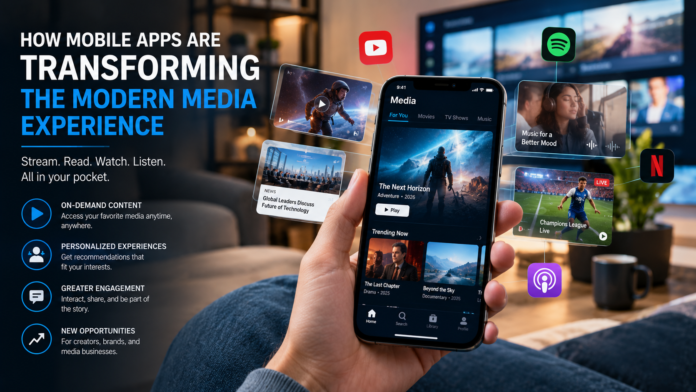
That experience the film as an entry point into a larger content ecosystem that the viewer navigates in real time describes something genuinely new about how media is consumed. Not just that people watch things on phones, which they do at rates that now exceed television for many demographics, but that the relationship between a piece of media and its audience has changed. The audience is now an active participant in a content experience that extends past the artifact itself, and the phone is the device that makes that participation frictionless. A thoughtful Mobile application development company building for media understands that the mobile media experience isn’t a degraded version of the television or cinema experience. It’s a genuinely different thing with different strengths that media businesses are only beginning to understand how to build around.
The Attention Economics Have Changed Permanently
Television’s dominance as a media consumption platform rested partly on its practical monopoly on moving-image content in the home. You watched what was scheduled when it was scheduled, on the device that had the screen, because the alternatives were genuinely inferior.
None of those conditions hold anymore. Every screen is now a potential media consumption surface. Content availability is effectively infinite. The scheduling constraint is gone time-shifted viewing through streaming has made “appointment television” a minority experience rather than the norm. And the competition for attention isn’t other television programs; it’s everything on the phone, which includes social media, messaging, games, news, and an inexhaustible supply of short-form video that’s been algorithmically selected to be maximally engaging for this specific viewer at this specific moment.
The media experience on mobile isn’t competing with traditional media on production quality or narrative depth, where traditional media often wins. It’s competing on availability, relevance, and frictionlessness and on these dimensions, well-built mobile media products have structural advantages that traditional formats can’t easily replicate.
Personalisation at the Content Level
The algorithmic personalisation that social platforms developed for engagement has moved into mainstream media consumption in ways that are still working themselves out.
Streaming services that personalise content discovery surfacing what a specific user is likely to want to watch next, based on viewing history, completion rates, browsing behavior, and patterns across similar users have demonstrated that recommendation quality is one of the primary drivers of subscriber retention. Netflix’s investment in recommendation systems is well-documented enough to be a case study in recommendation engineering; the finding that better recommendations measurably reduce churn has propagated through the industry.
The specifically mobile dimension of this is the discovery experience on small screens. The browsing interface that works on a television a grid of content with visible titles and artwork works differently on a phone, where the physical constraints of the screen mean less content is visible simultaneously and the interaction patterns are fundamentally different. Mobile-first media apps that have thought through discovery for touch interfaces rather than adapting television interfaces for small screens produce meaningfully better engagement among users who primarily access content on phones.
Audio is where mobile personalisation has been most commercially successful. Podcast recommendation engines, music discovery algorithms, and the emergence of spatial audio experiences designed specifically for headphone consumption have created a category of mobile audio media that didn’t exist coherently a decade ago. The AirPods-and-Spotify media stack is a genuinely new form of media consumption that emerged from the intersection of mobile hardware, streaming services, and recommendation algorithms none of which would have produced it independently.
Short-Form Video as a Distinct Format
Short-form video content designed for thirty seconds to three minutes rather than adapted from longer formats deserves specific consideration because it isn’t a simplified version of long-form video. It’s a distinct format with its own grammar, its own conventions, and its own relationship with the viewer.
The success of short-form video platforms has demonstrated that mobile users engage with video content in ways that don’t require narrative depth or production quality. They require immediacy, emotional resonance, and the sense that what they’re watching is worth the next few seconds of their attention. These are different properties from what makes a documentary compelling, and the creators who’ve built large audiences on short-form platforms have generally developed those skills independently from traditional media production skills.
For media businesses, short-form represents both an opportunity and a format mismatch. The opportunity is reaching audiences where their attention is, in a format those audiences have demonstrated preference for. The mismatch is that the production economics, creative skills, and distribution mechanics of short-form are substantially different from what traditional media production is organized around. The businesses navigating this most successfully have treated short-form as a distinct product requiring distinct investment rather than a channel through which to distribute clipped versions of existing content.
Live and Social Media Experiences
Simultaneous viewing watching something at the same time as other people and interacting around the shared experience is a form of engagement that television delivered through cultural ubiquity (everyone watching the same thing because it was the only thing on) and that mobile has partially reconstructed through social features.
Live sports streaming on mobile has retained the simultaneity that makes sports distinctly valuable as a media property, while adding the social layer of real-time commentary, statistics, and fan community interaction that phones enable. A sports viewer on mobile is simultaneously watching, accessing statistics, participating in fan community discussion, and occasionally placing in-app bets in markets where that’s available a media experience that has no parallel in traditional broadcast.
Live audio platforms and the experimentation with social listening listening to music or podcasts simultaneously with others and sharing the experience represent early attempts to reconstruct the social dimension of media consumption that physical co-viewing provided. Most of these experiments have had limited traction, which suggests the simultaneity of attention isn’t sufficient to create genuine social experience without the physical co-presence that made watching together feel like watching together.
What Building Media Products on Mobile Actually Costs
The question of MVP Development Cost for mobile media products varies considerably depending on the content category and the complexity of the personalisation and social features involved.
A basic audio streaming app with content library, playback controls, and simple recommendation can be built for $60,000 to $100,000 at MVP stage. A video streaming platform with content rights management, adaptive bitrate streaming infrastructure, personalisation, and offline download capability runs considerably higher $200,000 to $500,000 for a production-ready MVP, with content acquisition costs sitting entirely outside that development budget.
The infrastructure costs that media apps carry beyond the development budget are significant: content delivery networks that serve video and audio efficiently to large concurrent user bases are meaningful ongoing operational costs that need to be planned for from the beginning of the business rather than discovered at scale.
The media businesses that have gotten this right have planned their technology infrastructure as part of their content investment rather than separately from it. The streaming service that acquires compelling content but can’t deliver it reliably to mobile users in the diverse connectivity conditions its users actually have is investing in content that users can’t access when they want it which is not a functional media product regardless of how good the content is.
The Critic’s Changed Relationship With His Work
The film critic who spent forty minutes on supplementary content after a festival screening describes his relationship with media criticism differently now than he did five years ago. He writes shorter pieces more frequently, linking heavily to the supplementary content he would previously have embedded in a longer article. He thinks of each piece as an entry point rather than a complete statement.
That structural change in how he works reflects something real about how his readers encounter his work. They’re on phones. They’re moving between pieces of content in ways that reward clear entry points and discourage dense, self-contained articles that compete with everything else on the screen for sustained attention.
The media experience mobile has created isn’t better or worse than what preceded it in any absolute sense. It’s faster, more fragmented, more personalised, and more social and those properties are the ones that media businesses building for mobile need to design around rather than design against.
The film was good. The forty minutes it generated were also, arguably, the most engaged form of film criticism he’d produced in years because the format matched how his audience was already moving through the world.