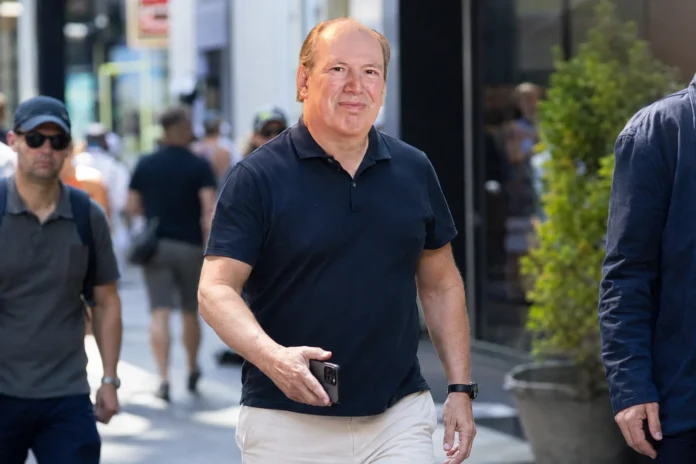
Few names in film carry as much weight as Hans Zimmer. From the roar of an orchestra in Gladiator to the ticking tension of Inception, this legendary composer has redefined how movies sound. If you’ve ever wondered who is Hans Zimmer, what drives him, or why his music feels so instantly recognizable, this guide walks through his story, his sound, and his ongoing influence on Hollywood.
Biography Table
| Field | Details |
|---|---|
| Full Name | Hans Florian Zimmer |
| Date of Birth | September 12, 1957 |
| Place of Birth | Frankfurt, West Germany |
| Age | 68 years old |
| Nationality | German |
| Zodiac Sign | Virgo |
| Profession/Occupation | Composer, record producer, sound designer |
| Years Active | 1980s–present (over four decades) |
| Genre/Field | Film score, orchestral, electronic music |
| Spouse/Partner | Vicki Carolin (m. 1982–1992), Suzanne Zimmer (m. late 1990s–2020) |
| Children | Zoë, Annabel, Brigitte, Jake |
| Net Worth | Estimated $200 million |
| Height | 5’10″–5’11” |
| Notable Works | The Lion King, Gladiator, The Dark Knight Trilogy, Inception, Interstellar, Dunkirk, Dune |
| Awards/Honors | Two Academy Awards, four Grammy Awards, two Golden Globes |
Hans Zimmer’s Early Life and Refuge in Music
Hans Zimmer was born in Frankfurt in 1957, the son of an engineer father and a musician mother. When his father died, Zimmer was only six years old, and music quickly became a refuge and emotional outlet during a difficult childhood spent moving between schools in Germany, Switzerland, and London.
He was never the best student, and by his own admission, his formal music education amounted to just a couple of piano lessons. Rather than following convention, Zimmer taught himself, drawn instead to keyboards, synthesizers, and the idea of inventing his own sound rather than copying existing scores.
A pivotal moment came from hearing Ennio Morricone’s score for Once Upon a Time in the West, which planted the idea that film music could be as unorthodox as it was powerful. That spark shaped his peculiar style long before Hollywood ever came calling.
From Rising Star to Hollywood’s Go-To Composer
Zimmer’s professional path began modestly in London during the 1970s and 1980s, working as a keyboard player and synth programmer for bands, including a stint with The Buggles, the group behind Video Killed the Radio Star. He also assisted composer Stanley Myers, a mentorship that opened doors into film music.
His first real breakthrough came scoring A World Apart, an anti-apartheid drama that earned him his first Academy Award nomination. That recognition, paired with his refusal to follow orchestral convention, caught the attention of directors looking for something different.
The true turning point arrived with Rain Man in 1988. Working alongside director Barry Levinson on the Dustin Hoffman and Tom Cruise drama, Zimmer built a minimalist, electronic-leaning score that became his international career beginning and Hollywood debut proper, earning him another Oscar nomination.
From there, his career accelerated at a pace few composers have matched. Today, Hans Zimmer movies span more than 150 films, and his soundtracks have contributed to a combined box office gross reportedly exceeding $36 billion worldwide.
The Lion King and His First Oscar Win
If one score introduced Hans Zimmer to a global, multigenerational audience, it was The Lion King in 1994. Blending African melodies, epic orchestration, and raw emotion, the soundtrack became one of Disney’s most identifiable pieces of music.
The Lion King earned Zimmer his first Best Original Score Oscar, cementing him as a serious force beyond the action and drama genres he’d built his name in. It remains one of his most famous works, still instantly recognizable decades later.
That same year, Zimmer also composed The Prince of Egypt for DreamWorks alongside Stephen Schwartz, a soundtrack that leaned into the studio’s rivalry with Disney and further proved his range across animated storytelling.
Gladiator, The Dark Knight, and the Rise of the “Zimmer Sound”
The year 2000 brought Gladiator, a score defined by severe strings, melancholic themes, and Lisa Gerrard’s haunting vocals layered over hostile, ancient landscapes. It became one of Zimmer’s most critically and commercially successful works, blending percussion, choirs, and powerful heroic motifs.
Then came Batman Begins in 2005 and The Dark Knight in 2008, both created with James Newton Howard. These scores fused traditional orchestration with distorted electronics, giving Gotham City a sound as unstable as its villains. The Joker’s theme, built on the now-famous “Why so serious” tension, became a defining moment in dramatic superhero scoring.
By this point, Zimmer’s approach, layering synthesizers, sampled strings, invented instruments, and a full orchestra, had become known simply as the “Zimmer sound”: unorthodox, emotionally direct, and unlike anything else coming out of Remote Control Productions, his own studio and mentorship hub for future composers like Ramin Djawadi, Lorne Balfe, and Junkie XL.
Inception, Interstellar, and the Christopher Nolan Era
Zimmer’s collaboration with director Christopher Nolan produced some of the most talked-about scores in modern cinema. Inception (2010) introduced the now-iconic BRAAAM, deep sounds built using the Shepard Tone, an auditory illusion that creates the sensation of an infinitely rising pitch.
Interstellar (2014) shifted direction entirely. Centered on an organ, the score leaned into the human and family dimension of the story, a father leaving his child, rather than pure spectacle. Zimmer has said he wrote the piece before even reading the full script, working instead from a short story Nolan gave him.
The Nolan partnership continued through Dunkirk, using the same ticking-clock tension technique borrowed from screenwriting itself. Zimmer has described Nolan as his creativity soulmate, a working relationship built on trust, experimentation, and years of shared cinematic language.
Dune and Otherworldly Sound Design
For Denis Villeneuve’s Dune (2021), Zimmer built an entirely new sonic language from scratch. Inspired by the sound of the desert, he combined invented instruments, tribal percussion, provocative surround sound design, and unheard textures to create something genuinely otherworldly.
The score earned Zimmer his second Academy Award and proved that even after four decades, he was still willing to abandon familiar tools. He has spoken about needing new instruments and unfamiliar techniques for Dune specifically, refusing to lean on his existing sound library.
Dune: Part Two followed in 2024, expanding the same musical world, with Dune: Part Three anticipated for future release as the saga continues.
The Hans Zimmer Sound: Studio, Tools, and Technique
Understanding Hans Zimmer music means understanding his studio. Over four decades, he’s built a personal setup layered with vintage synths, analog polysynths like the Minimoog and Yamaha CS-80, a Fairlight CMI sampler, and modern tools like the u-he ZebraHZ soft synth and Universal Audio UAD-2 systems.
He’s long been associated with MPE (MIDI Polyphonic Expression) technology, particularly the Seaboard, an expressive keyboard controller that lets him bend, glide, and shape notes the way a violinist or guitarist would, rather than being locked into rigid keyboard triggers.
His process blends idea generation, often described as his favorite part, with long stretches of overlaying sound, borrowing techniques from other disciplines, and refusing ideas he considers too safe. Zimmer has said his worst idea is usually the one he initially loved most, a reminder that revision is central to his craft.
Hans Zimmer Concerts, Tours, and Live Performances
Beyond the studio, Hans Zimmer concert experiences have become a phenomenon of their own. Hans Zimmer live shows translate cinematic scores into full stage productions, complete with a large orchestra, guitarists, and elaborate lighting design.
The World of Hans Zimmer, billed as A New Dimension, has toured across cities including Paris, Lyon, Bordeaux, Toulouse, and Brussels, alongside international stops. These Hans Zimmer tour dates draw massive crowds, some of whom may never have listened to a film score outside its original movie context.
He’s also performed at major festivals like Coachella, stepping outside the traditional concert hall into a completely different kind of crowd, something he’s admitted brings genuine stage fright even after decades composing for the world’s biggest films.
Hans Zimmer’s Net Worth and Career Impact
With an estimated net worth of around $200 million, Hans Zimmer ranks among the top-earning composers globally, built through movie composing fees, royalties, and increasingly lucrative live concert tours. His income streams now rival many performing musicians, not just fellow composers.
His commercial footprint is difficult to overstate. Movies composed by Hans Zimmer have grossed a combined total that puts him roughly $7 billion ahead of other top-earning film composers, driven by franchises like Pirates of the Caribbean, the Batman trilogy, and the Dune series.
Beyond his own scores, Zimmer’s influence runs through Remote Control Productions, the studio that has launched the careers of numerous working Hollywood composers, extending his impact well past his own credited films.
Awards, Recognition, and Legacy
Zimmer’s trophy case includes two Academy Awards, for The Lion King and Dune, along with four Grammy Awards and two Golden Globes. Across a career spanning more than 150 films, he’s received numerous additional nominations recognizing his range across genres.
What separates his legacy isn’t just the volume of hardware, it’s the influence. Composers working today across action films, dramas, and franchise blockbusters routinely borrow techniques he pioneered: blending electronic and orchestral textures, using sound design as emotional shorthand, and treating a film score as a character in its own right.
What’s Next for Hans Zimmer
Zimmer remains active well into his late sixties. Recent projects include a score for an F1 film, continued collaboration with Denis Villeneuve on the Dune franchise, and ongoing European tour dates extending into 2025 and 2026.
He’s also expanded into unexpected territory, including television work like Euphoria and continued interest in projects with longtime collaborators such as Pharrell Williams and Christopher Nolan. For a composer already past the 150-film mark, the pace shows little sign of slowing.
FAQs
Who is Hans Zimmer?
Hans Zimmer is a German film composer born in Frankfurt in 1957, known for scoring more than 150 movies including The Lion King, Gladiator, Inception, and Dune. He’s widely regarded as one of the most influential and commercially successful composers in Hollywood history.
What movies has Hans Zimmer composed music for?
Movies composed by Hans Zimmer include The Lion King, Gladiator, the Dark Knight trilogy, Inception, Interstellar, Dunkirk, the Pirates of the Caribbean series, Man of Steel, and Dune. His filmography spans animation, action, drama, and science fiction genres.
What is Hans Zimmer’s net worth?
Hans Zimmer’s estimated net worth is around $200 million, built primarily through film scoring fees, music royalties, and increasingly popular live concert tours under The World of Hans Zimmer.
Is Hans Zimmer still touring?
Yes, Hans Zimmer continues to tour internationally through The World of Hans Zimmer live shows, with dates across major European cities. These concerts translate his film scores into full orchestral stage productions.
How did Hans Zimmer get started in Hollywood?
Hans Zimmer’s Hollywood breakthrough came with Rain Man in 1988, directed by Barry Levinson. Before that, he worked as a synthesizer programmer and keyboardist in London, eventually mentoring under composer Stanley Myers.
What awards has Hans Zimmer won?
Hans Zimmer has won two Academy Awards, for The Lion King (1994) and Dune (2021), along with four Grammy Awards and two Golden Globes across his career.
What makes the Hans Zimmer sound unique?
The Hans Zimmer sound blends traditional orchestral arrangements with electronic music, synthesizers, and invented instruments. His use of sound design as an emotional storytelling tool, rather than just background music, is considered a defining shift in modern film scoring.
Read About : elvis