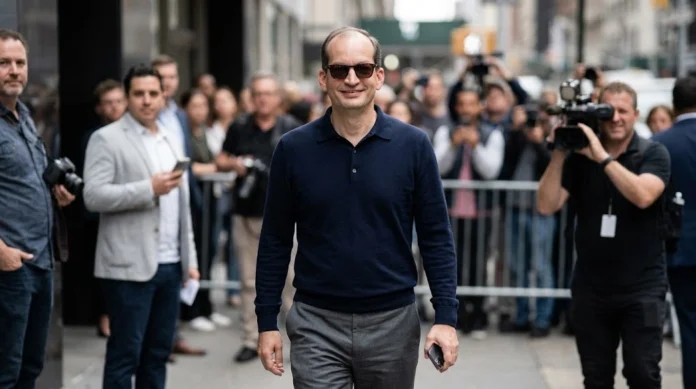
Alex Acosta is a Harvard-trained lawyer and former U.S. Attorney who became Trump’s first labor secretary in 2017. Many people remember him because of one decision: the 2008 nonprosecution deal he approved for Jeffrey Epstein. That deal ended his cabinet career in 2019. It also brought him back before Congress in 2025, more than a decade later. This guide covers the full story, including his early life, his record at the Labor Department, the Epstein case, his family, and where he is now.
Biography Table
| Field | Details |
|---|---|
| Full Name | Rene Alexander Acosta |
| Nickname | Alex Acosta |
| Date of Birth | January 16, 1969 |
| Place of Birth | Miami, Florida, U.S. |
| Age | 57 (as of October 2026) |
| Nationality | American |
| Zodiac Sign | Capricorn |
| Ethnicity | Cuban-American (Hispanic) |
| Profession/Occupation | Attorney, former U.S. Secretary of Labor, former law school dean |
| Years Active | 1994–present |
| Education | Gulliver Schools; Harvard College (A.B., Economics, 1990); Harvard Law School (J.D., cum laude, 1994) |
| Genre/Field | Law, labor and employment policy, civil rights, federal prosecution |
| Spouse/Partner | Jan Williams Acosta |
| Children | Two daughters, Delia and Rosalia |
| Parents | Cuban immigrant parents (father: Rene Acosta) |
| Notable Works | 27th U.S. Secretary of Labor; U.S. Attorney for the Southern District of Florida; Dean of FIU College of Law; Assistant Attorney General for Civil Rights |
| Awards/Honors | Twice named one of the 50 most influential Hispanics in the U.S. by Hispanic Business magazine |
Who Is Alex Acosta? Early Life and Education
Alex Acosta is a Miami-born attorney and the only son of Cuban immigrants. His full name is Rene Alexander Acosta, and he was born on January 16, 1969. He grew up in South Florida, a region that shaped his ties to the Cuban-American community and later to Florida’s legal and political world.
He attended the Gulliver Schools in Miami before heading to Harvard College. He earned a degree in economics in 1990. He was the first in his family to graduate from college, a detail he often mentioned when talking about opportunity and work.
Acosta stayed at Harvard for law school and graduated cum laude from Harvard Law in 1994. In my experience researching political biographies, this path explains a lot about him. Elite schooling gave him credentials, while his immigrant family story gave him a relatable public message. Both helped him later during Senate confirmations.
Legal and Government Career Before the Labor Department
After law school, Acosta clerked for Samuel Alito, who was then a judge on the Third Circuit in Philadelphia. He then joined Kirkland & Ellis in Washington, where he focused on employment and labor law. He also taught law before entering government service.
His rise in government came quickly under George W. Bush. The table below shows the main steps:
| Year | Role |
|---|---|
| 1994–1995 | Law clerk to Judge Samuel Alito, Third Circuit |
| 2002–2003 | Member, National Labor Relations Board (NLRB) |
| 2003–2005 | Assistant Attorney General, DOJ Civil Rights Division |
| 2005–2009 | U.S. Attorney, Southern District of Florida |
| 2009–2017 | Dean, FIU College of Law |
| 2013–2017 | Chairman, U.S. Century Bank |
| 2017–2019 | U.S. Secretary of Labor |
At the Civil Rights Division, Acosta led anti-trafficking campaigns and supported religious freedom cases. One well-known example was the federal intervention for a Muslim student in Oklahoma who was barred from wearing a hijab at school. This case gave him a reputation as a principled conservative on civil rights.
As U.S. Attorney in Miami, he prosecuted major cases. His office went after leaders tied to the Cali drug cartel and handled the Florida fraud case against lobbyist Jack Abramoff. It also pursued large health care fraud cases across southern Florida, including offices in Miami and beyond.
In 2009 he became the second dean of FIU’s law school. During those years he also chaired a Miami community bank, which gave him private-sector and banking compliance experience. This profile made him a safe pick when the White House needed a quick replacement in 2017.
Civil Rights Division Controversies
His time at the Civil Rights Division was not free of criticism. A later Inspector General report found that a senior official under him, Bradley Schlozman, had illegally used politics in hiring decisions. The report said Acosta’s oversight of that official was weak.
Critics also pointed to the division’s shift away from traditional employment discrimination cases toward other priorities. Some former staff said fewer race-based discrimination and Voting Rights Act cases moved forward during that period.
In 2004, Acosta also sent an unsolicited letter brief in an Ohio voter-challenge dispute. Critics said it supported practices that could keep eligible voters from the polls. These controversies came up again during his confirmation hearings, though they never became as damaging as the Epstein case.
Alex Acosta and the Jeffrey Epstein Non-Prosecution Agreement
The Alex Acosta Epstein connection is the single biggest reason people search for him today. As U.S. Attorney, Acosta’s office handled the first federal Epstein investigation. Instead of filing federal charges, his office signed a secret Non-Prosecution Agreement in 2007, and Epstein pleaded guilty to state charges in 2008.
The FBI investigation had identified dozens of underage victims. Federal prosecutors had even drafted a 60-count federal indictment. Yet the final outcome sent Epstein to a local jail on lesser state charges, while the federal government stepped aside.
Critics called it a “sweetheart deal” because of how lenient it was. Acosta has always argued that the deal was better than risking a loss at trial. That debate, between real-world risk and justice for victims, is still the heart of this story.
What the 2007–2008 Deal Actually Included
The gap between what was possible and what happened is easiest to see side by side:
| Issue | Federal Draft Plan | Final Deal Outcome |
|---|---|---|
| Charges | 60-count draft federal indictment, including possible human-trafficking charges | Guilty plea to two lesser state prostitution charges |
| Sentence | Potential long federal prison term | 18-month sentence; served about 13 months |
| Custody | Federal prison | Local jail with work release 12 hours a day, six days a week |
| Others involved | Possible federal charges for accomplices | Immunity for named and unnamed co-conspirators |
| Victims | Federal crime victims’ rights | Victims not told before the deal was signed |
Epstein did have to register as a sex offender and pay restitution to some victims through a civil process. But the work release term drew the most anger. He was allowed to leave jail for most of the day during his sentence.
The deal also blocked federal prosecution of potential co-conspirators. That clause became important years later, when lawyers for others linked to Epstein tried to use it as a shield.
Prosecutor Villafaña’s Objections
A. Marie Villafaña was the lead prosecutor on the federal case. She built the draft indictment and pushed for stronger charges. Records later showed she opposed several terms that benefited Epstein.
Epstein’s lawyers held meetings with Acosta and senior staff, and many of Villafaña’s objections were overruled. The defense team’s stature was hard to ignore, since it included some of the most prominent lawyers in the country.
The DOJ review later found no evidence that Acosta was improperly influenced by the defense. Still, critics argue that the pressure from Epstein’s legal team shaped the final terms. This internal disagreement is one reason the case still feels unresolved to many readers.
The February 2019 Court Ruling on Victims’ Rights
In February 2019, a federal judge in Florida ruled that prosecutors broke the law. The judge found that they violated the Crime Victims’ Rights Act by hiding the deal from Epstein’s accusers before it was finalized.
The victims’ rights case had been filed back in 2008. More than 30 underage victims were part of the broader case record. The ruling confirmed what victims had said for over a decade: they were kept in the dark about the plea agreement.
The ruling did not overturn the deal itself, and the victims did not get the full remedy they sought. But it gave House Democrats and critics strong legal grounds to question Acosta’s judgment while he was still in the cabinet.
Confirmation and Tenure as Labor Secretary (2017–2019)
Acosta was not Trump’s first choice for the job. The original pick, Andy Puzder, withdrew after criticism. Trump announced Acosta as his new Labor Secretary pick only a day later, in February 2017.
The Senate confirmed him on April 27, 2017, by a 60-38 vote, with bipartisan support. He became the 27th labor secretary and the only Hispanic member of Trump’s original cabinet. Ironically, the Epstein plea deal came up in his confirmation hearings, but it barely slowed him down at the time.
At the Labor Department, he led an agency that enforces laws covering around 125 million workers. His main focus was expanding apprenticeship programs, which he saw as a practical path to skilled jobs without heavy student debt.
He also worked to cut regulations and roll back several Obama-era rules. However, his pace was slower and more careful than many in the White House wanted. By January 2019, renewed reporting on the Epstein case had put his tenure under real pressure.
The July 2019 Press Conference and Resignation
In July 2019, federal prosecutors in New York filed new SDNY charges against Epstein. This brought fresh calls for Acosta’s resignation. He responded with a long press conference to defend the deal.
He argued that state authorities were ready to let Epstein go with a lighter punishment. His office, he said, stepped in to make sure Epstein went behind bars, registered as a sex offender, and paid restitution. He called Epstein’s work release “unacceptable” but said it was approved at the state level.
He also said he wouldn’t resign and that the circumstances of 2008 differed from today. Many viewers felt he did not show enough concern for the victims. In my view, the press conference failed because he defended the outcome without fully addressing the process.
Two days later, on July 12, 2019, Acosta announced his resignation at the White House alongside Trump. He said he did not want the Epstein story to distract from the economy and the agency’s goals. The decision followed bipartisan criticism and growing pressure from congressional Democrats.
Deputy Secretary Patrick Pizzella became acting secretary when Acosta left office a week later. Trump then nominated Eugene Scalia, son of Justice Antonin Scalia, to replace him permanently.
Acosta vs. Pizzella: A Change in Style at Labor
Inside the administration, Acosta was seen as cautious and contemplative. White House officials, including acting chief of staff Mick Mulvaney, were reportedly frustrated with his slow pace on deregulation.
Pizzella brought a more decisive approach. Former officials described the change in style as a shift from careful review to faster action on rolling back rules.
Labor lawyers like Paul DeCamp, a former official at the department, noted that the agency moved with more urgency after Acosta’s exit. This contrast helps explain why Acosta had limited support inside the White House when the Epstein pressure peaked.
The 2020 DOJ Office of Professional Responsibility Report
After the February 2019 ruling, the DOJ Office of Professional Responsibility (OPR) opened a probe into how five Florida prosecutors resolved the case. Acosta was the central figure in the review.
In November 2020, OPR released a report that ran hundreds of pages. It was based on documents and sworn interviews. The report found that Acosta exercised “poor judgment” but did not commit professional misconduct.
The report also called the treatment of victims troubling, especially the failure to keep them informed. Victims’ attorneys rejected the findings and called the investigation a whitewash. For them, “poor judgment” was far too soft a label for what happened.
House Oversight Committee Testimony (2025)
On September 19, 2025, Acosta sat for a closed-door transcribed interview with the House Oversight Committee. It was his first congressional questioning on the Epstein case, and it lasted about six hours.
Speaking under oath, Acosta repeated his long-held view. He said prosecutors feared losing at trial, and the deal was a way to guarantee some jail time and a sex-offender label. He also said he had never met Epstein.
Chairman James Comer said the testimony helped clarify the original deal. Ranking Member Robert Garcia and other Democrats were less satisfied. They pressed him on the immunity for co-conspirators, the victims’ compensation terms, and Epstein’s work release. Some members said the system had clearly dropped the ball on accountability.
The questioning also touched on Ghislaine Maxwell, Epstein’s longtime associate. The co-conspirator clause in the 2007 deal had come up in her own legal fight, which made Acosta’s answers more relevant to the present day.
Transcript Release and the Trump Question
On October 17, 2025, the committee released the 172-page transcript. Much of the public interest focused on whether Trump’s name came up in the original case.
Acosta testified that he had no relevant information linking Trump to Epstein’s crimes from the 2007 case. Some coverage treated this as clearing Trump, while Oversight Democrats said it did not answer every question.
The transcript also described the deal as a gamble taken to avoid a federal trial loss. Critics, however, continue to call the 2008 agreement the “original sin” of the Epstein saga. The same committee also sought testimony from other former top officials, showing how wide the investigation had become.
Alex Acosta Wife and Family Life
Alex Acosta’s wife is Jan Williams Acosta. She has kept a low public profile throughout his career. She appeared publicly at his 2017 swearing-in ceremony as labor secretary.
The couple has two daughters, Delia and Rosalia. Acosta often referred to his daughters in speeches, especially when talking about work, education, and opportunity for the next generation.
Is Alex Acosta still married? Based on public records, he remains married to Jan, and there are no credible reports of a divorce or separation. Be careful with some online bios that list a different wife’s name; those claims are not supported by public records.
Alex Acosta Astroworld: Clearing Up a Common Mix-Up
Many people search “Alex Acosta Astroworld,” but the former labor secretary has no link to that event. The confusion comes from a similar name: Axel Acosta.
Axel Acosta was a 21-year-old computer science student at Western Washington University. He was one of the people killed in the crowd crush at the Astroworld Festival in Houston in November 2021, during Travis Scott’s performance.
He had traveled alone from Washington state to attend the concert. His family later joined legal action against the event organizers. If you were looking for information about the Astroworld victim, this is the person you mean, not the former U.S. Attorney.
Where Is Alex Acosta Now?
So, where is Alex Acosta now? Since leaving office in 2019, he has moved into the private sector. He holds corporate board roles, including a seat on the board of Newsmax, the conservative media company, which went public in March 2025.
Alex Acosta today keeps a much lower profile than during his cabinet years. He rarely gives interviews and does not seek public office. His public appearances now mostly come when the Epstein case resurfaces.
That still happens often. In 2026, the Epstein Transparency Act pushed the DOJ to release more Epstein files. These documents brought fresh questions about Acosta’s conduct in Florida and the influence of Epstein’s legal team. For Alex Acosta now, the 2008 deal remains the part of his long record of service that defines him most in public memory.
FAQs
Who is Alex Acosta?
Alex Acosta is an American attorney and former U.S. Secretary of Labor who served from 2017 to 2019. Before that, he was the U.S. Attorney in Miami and the dean of FIU’s law school. He is best known for approving the 2008 Epstein plea deal.
What was the Alex Acosta Epstein sweetheart deal?
It was a secret Non-Prosecution Agreement that let Epstein avoid federal charges. Epstein pleaded guilty to two state charges and served about 13 months, much of it on work release. The deal also gave immunity to possible co-conspirators.
Why did Alex Acosta resign?
He resigned in July 2019 after new federal charges against Epstein in New York renewed anger over the 2008 deal. He said he did not want the case to distract from the Labor Department’s work. His resignation followed criticism from both parties.
Who is Alex Acosta’s wife?
Alex Acosta’s wife is Jan Williams Acosta. The couple has two daughters, Delia and Rosalia. She has largely stayed out of the public spotlight.
Was Alex Acosta found guilty of misconduct?
No. The DOJ’s 2020 review found that he showed poor judgment but did not commit professional misconduct. Victims’ lawyers strongly disagreed with that conclusion.
Is Alex Acosta connected to Astroworld?
No. The Astroworld victim was Axel Acosta, a 21-year-old student from Washington state. The similar name causes frequent mix-ups in search results.
Read About : baron trump